Blog · Probiotics
What CFU Means on a Probiotic Label, and What SlimTide's Label Shows
CFU stands for colony-forming units: the number of live microbes that can grow into a colony. It is the useful count for a probiotic. A weight in milligrams is not, because NIH says it can include dead cells (NIH ODS: probiotics). The SlimTide label prints its probiotic blend as 36 mg, with no CFU count and no strain codes.
Written by the Slimtidebalance editorial teamUpdated · 9 min read

The basics
What does CFU mean on a supplement label?
CFU means colony-forming units. It counts the microbes in a dose that are alive and able to multiply, and NIH calls it the measure to look for on a probiotic label (NIH ODS: probiotics).
A lab spreads a sample on a growth plate. Each live cell grows into a dot, called a colony, and the dots are counted.
Counts on labels are often written as billions, such as 10^10. The more useful questions are simpler. Are the cells still alive when you swallow them, and was that strain tested at that count?
The reason live cells matter comes from the definition itself. An expert panel defined probiotics as live microorganisms that, given in adequate amounts, confer a health benefit (ISAPP: probiotic consensus (2014)).
Milligrams vs CFU
Why is a weight in milligrams not the same as a CFU count?
A weight tells you how much material went in, not how much of it is alive. NIH says labels must list the total weight of the microorganisms, and that weight can include dead ones (NIH ODS: probiotics). Listing CFU is voluntary.
| Question | Weight (mg) | CFU count |
|---|---|---|
| Required on the label? | Yes, the total weight of microbes | No, voluntary |
| Counts only live cells? | No, can include dead ones | Yes, cells that can form colonies |
| Can you compare it with a study? | Rarely; trials report cell counts | Yes, if the strain matches too |
| Shown on the SlimTide label? | Yes, 36 mg for the blend | Not published |
That last row is the honest gap. Our probiotics and CFU page covers what that means for each strain.
Shelf life
What does "CFU at end of shelf life" mean, and why does it matter?
It means the count is promised for the last day the product is good, not the day it was made. NIH advises looking for CFU at the end of shelf life, because probiotics can die while a bottle sits on a shelf (NIH ODS: probiotics).
A count "at time of manufacture" can be true and still mislead. The ISAPP expert panel says the word probiotic should apply only to products with an appropriate viable count at the end of shelf life (ISAPP: probiotic consensus (2014)).
Storage changes the numbers. In one study of commercial probiotic products, cold storage at 4C kept bacteria alive better than storage at 28C, and one of four products tested below the count on its label (Probiotic storage and viability (2018))." That was a small study, so treat it as a warning sign, not a verdict on any brand.
The label reads "Refrigerate for optimal quality," and the sales page says to refrigerate after opening to preserve the probiotics. That fits NIH's note that some probiotics need refrigeration (NIH ODS: probiotics). The label also says "store in a cool, dry place." A fridge is both, so the fridge is the simple answer once the bottle is open.
Strain codes
What is a probiotic strain code, and why does it matter?
A strain code is the letters and numbers after a species name. It marks one exact line of bacteria, the way a model number marks one version of a car. Effects are strain-specific, NIH says, so a result for one strain does not carry over to another (NIH ODS: probiotics) (NCCIH: probiotics safety).
Genus
The family name, like Bifidobacterium. It says little about what a product does.
Species
The second word, like infantis. Closer, but one species holds many strains.
Strain
A code after the species. Studies test at this level, so labels need it too.
Without a strain code, you can only look up the species, which may cover strains never tested for anything you care about. The ISAPP panel calls for well-defined strains for this reason (ISAPP: probiotic consensus (2014)).
Form matters too. The main human study of Akkermansia muciniphila used about 10 billion pasteurized cells a day, meaning heat-treated, for three months in a small pilot (Akkermansia pilot study (2019)). A label without the form or the count cannot be compared with that study. More on that on our Akkermansia page.

Try SlimTide for 60 days1 capsule a day · from $49 a bottle · free U.S. shipping on 3+ bottles
Order nowThe SlimTide label
What does the SlimTide label show about its probiotics, and what does it leave out?
The SlimTide label names three probiotic species in one 36 mg Probiotic Blend: Bifidobacterium infantis, Clostridium butyricum and Akkermansia muciniphila. It prints no CFU count, no strain codes and no split between the three.
That is better than labels that name only a genus. It is still less than a shopper needs to judge the probiotic part.
Shown on the label
- All three species, by full name
- The blend weight: 36 mg per capsule
- Both fiber amounts: 211 mg inulin, 100 mg potato starch
- A cold-storage direction that suits live microbes
Not on the label
- A CFU count, at any date
- Strain codes for any of the three
- How the 36 mg splits between species
- Whether the Akkermansia is live or pasteurized
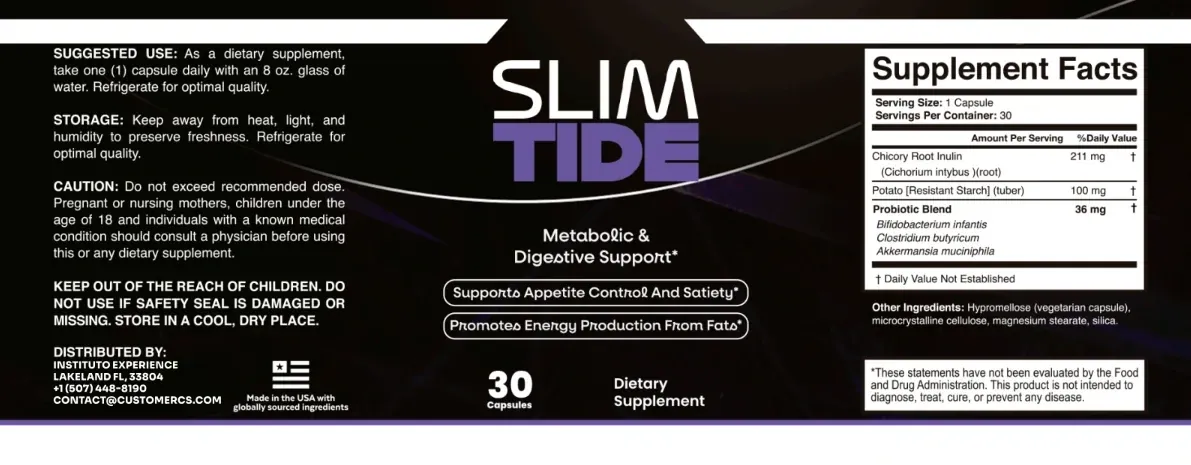
Every line of the label is typed out on the SlimTide Supplement Facts page.
Questions
What should you ask before buying a probiotic with no CFU listed?
Ask the seller for the count and strains in writing. For SlimTide, start with the order desk at +1 (302) 200-3480. Useful questions:
- What is the CFU count per capsule, and is it guaranteed at the end of shelf life?
- What are the strain codes for each of the three species?
- Is the Akkermansia live or pasteurized?
- How much of the 36 mg blend is each species?
If no answers come, judge it on what is printed: two small fiber amounts plus a blend of unknown size. Our ingredients overview weighs each one.
One safety point stands apart from any label. NCCIH says the risk of harm from probiotics is greater in people with severe illness or a weakened immune system, and that some products contain microbes not listed on the label (NCCIH: probiotics safety). If that describes you, ask your doctor before taking any probiotic.
Bottom line
What is the short take on CFU and SlimTide?
CFU is the count of live microbes, and the date it applies to matters as much as the number. SlimTide names its three species and asks you to refrigerate, which is good. It prints no CFU and no strain codes, so the probiotic part cannot be matched to any study. Weigh it as a small fiber capsule with an unmeasured blend.
FAQ
CFU on probiotic labels: common questions
What does CFU stand for on a probiotic?
CFU stands for colony-forming units. It counts the microbes in a dose that are alive and able to grow into a colony on a lab plate. NIH says CFU is the figure to look for, and that the most useful count is the one guaranteed at the end of shelf life.
How many CFU are in SlimTide?
The SlimTide label does not print a CFU count. It lists a 36 mg Probiotic Blend of Bifidobacterium infantis, Clostridium butyricum and Akkermansia muciniphila, with no split between them. To get a count, ask the order desk at +1 (302) 200-3480 in writing.
Is 36 mg of probiotics a lot?
A weight cannot tell you. NIH says the milligram figure on a probiotic label is the total weight of the microbes and can include dead cells. Without a CFU count, 36 mg could hold many live cells or few.
Why do some probiotics need to be refrigerated?
Live bacteria die faster with heat, moisture and time. NIH notes that some probiotics need refrigeration, and a storage study found that 4C kept bacteria alive better than 28C. The SlimTide label says to refrigerate for optimal quality, so keep the open bottle in the fridge.
What is a strain code on a probiotic label?
A strain code is the string of letters and numbers after the species name. It identifies one exact line of bacteria. Because effects are strain-specific, the code is what lets you match a product to the study behind it. The SlimTide label prints no strain codes.
Is the Akkermansia in SlimTide live or pasteurized?
The label does not say. The main human Akkermansia pilot used about 10 billion pasteurized cells a day for three months, and its weight change was not statistically significant. Without the form and count on the label, you cannot compare SlimTide's Akkermansia with that study.
Who wrote this
Written and reviewed by
A small team that reads the SlimTide label line by line, checks every number against public health sources (NIH ODS, NCCIH, CDC, NIDDK, FDA, FTC) and published trials, and rewrites it in plain English. We do not write for the manufacturer, and we update a page whenever the label, the prices or the evidence changes.
Last updated . Read our editorial standards and how we check reviews. This website is run by a USA authorized retailer, not by the manufacturer. We earn money when you buy through our order links.
Keep reading
More about SlimTide

Probiotics and CFU
Three species, one 36 mg line, no CFU: how to read SlimTide's probiotics and keep them cold.
Read moreSupplement Facts
Every line of the SlimTide label, with what the 36 mg probiotic weight can and cannot tell you.
Read moreAkkermansia muciniphila
What one small pilot says about Akkermansia, and what the SlimTide label leaves out: count, form and share of the blend.
Read moreUSA authorized SlimTide retailer
Ready to try SlimTide?
Pick a pack. At one capsule a day, every pack lasts at least 60 days, the whole money-back window.
- Secure checkout
- 60-day money-back guarantee
- Ships from the U.S.